BLOGS
Educational blogs for parents and professionals
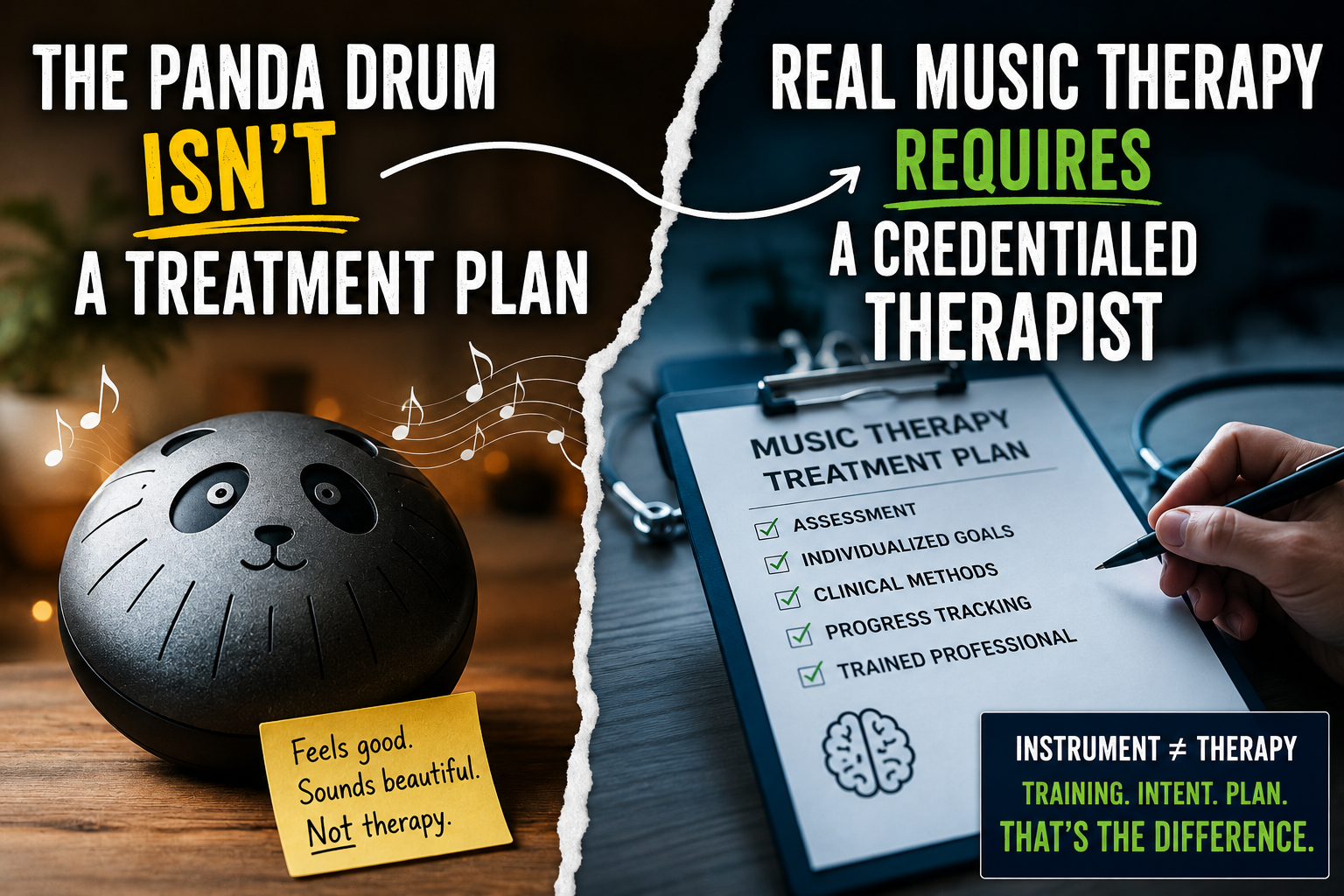
The Panda Drum Isn’t a Treatment Plan: Why Music Therapy Requires a Credentialed Therapist
Let’s be honest about this!
There’s is a viral push right now about steel tongue drums (like the Panda Drum®) that it can be beautiful and accessible instruments. Many people genuinely enjoy them for relaxation, creativity, and connection.
BUT… viral videos and ads are increasingly blurring a critical line: an instrument that feels calming is not the same thing as clinical music therapy.
As a licensed therapist with over two decades of experience specializing in marriage and family therapy, expert child therapist, as well as music therapy, I recognize and want to share the significance of this matter. My training encompasses neurological science-based research and practice in the use of music in therapy. When marketing implies therapy-like outcomes, particularly for children with autism, individuals with disabilities, those grappling with anxiety, trauma, sleep disturbances, or neurological conditions, families may be misled into believing that purchasing a product substitutes for a professional evaluation and an individualized treatment plan. Not all music is therapy!
This article is a research-informed, consumer-friendly explanation of what music therapy actually is, why credentials and expertise matter, and how to use instruments responsibly.
The core truth: the instrument isn’t the therapy
A drum can support:
Play
Sensory input
Co-regulation with a trusted adult
Mindfulness routines
Joy and creativity
Music therapy is different…
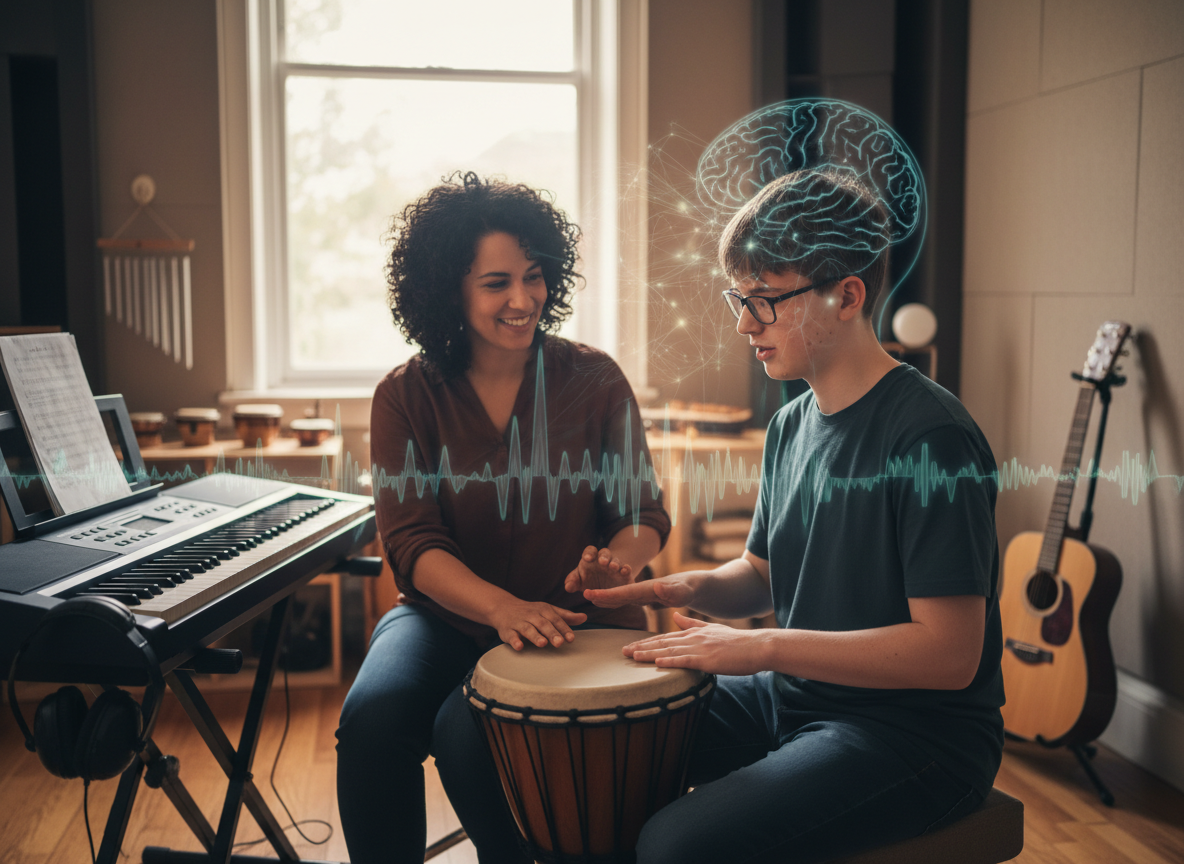
Music therapy is a clinical service where a trained professional uses music intentionally to address individualized goals.
In other words:
The product is an instrument.
Therapy is a process.
A treatment plan is a document with goals, methods, and measurable outcomes.
A child sitting alone and tapping a drum may have a positive experience but that is not automatically a therapeutic intervention.
Why this is going viral: “wellness language” sounds like healthcare
On the Panda Drum® collection page, the messaging repeatedly links the instrument to health and wellness outcomes. Examples include: Click here to review their page
“Escape to Calmness” and “Feel the stress melt away with every note”
“Soothing sounds help you relax naturally”
“Enhances sleep quality”
“432 Hz healing frequency for mind and body”
“Healing Resonance” language suggesting sound “mends”
Some of this is subjective marketing language. The risk is when it’s interpreted as a guaranteed clinical effect or when it’s used to imply the instrument itself functions like treatment.
If you’re a parent or paraprofessional trying to help a child who is anxious, dysregulated, or struggling socially, it’s understandable to want something simple that “works”, especially music which most children connect with.
But evidence-based care is rarely one-size-fits-all.
What research-based music therapy actually involves
1) Assessment (not guessing)
A credentialed music therapist doesn’t start with “here’s an instrument, go play.” They start with an indepth assessment.
Depending on the setting and goals, assessment may look at:
Sensory preferences and sensitivities
Attention, impulse control, and arousal level
Communication (verbal and nonverbal)
Motor planning and coordination
Emotional regulation and coping skills
Social interaction and relationship patterns
Family routines and stress points
This is where the therapy becomes individualized. Two clients can look “similar” online and need completely different approaches, even use of instruments.
2) A treatment plan with goals (not vibes)
A treatment plan typically includes:
Clear goals (what we’re targeting)
Methods/interventions (how music will be used)
Frequency/duration (how often, how long)
Progress measures (how we’ll know it’s working)
Adjustments over time (what changes when the data changes)
A product can’t do that by itself.
3) Intentional interventions (not random playing)
Research-informed music therapy uses music as a clinical intervention, applied intentionally and often in very specific ways. Examples:
Rhythm for regulation: matching a client’s arousal level, then gradually shaping tempo and intensity
Structured turn-taking: building communication and social reciprocity through predictable musical exchanges
Song-based coping tools: pairing breathing, grounding, and self-talk with musical cues
Motor and timing support: using rhythmic cueing for movement patterns, coordination, or sequencing
Trauma-informed work: using choice, predictability, and safety in musical experiences to support nervous system stabilization
The difference is not the instrument. The difference is the clinical decision-making behind how it’s used.
Neurology + music: why training matters
Music is powerful because it engages multiple brain systems at once:
Auditory processing
Attention networks
Motor planning and timing
Memory and learning
Emotion and reward pathways
Social cognition and connection
That “whole brain” engagement is one reason music can be so effective in healthcare.
But it’s also why it can be misused.
A trained clinician understands:
How to slowly introduce stimulation (not overwhelm)
How to structure experiences for safety and predictability
How to select interventions based on diagnosis, goals, and response
When music is contraindicated or needs modification
This is especially important for neurodivergent clients and for people with trauma histories, seizure disorders, sensory processing differences, or complex mental health needs.
What is Neurologic Music Therapy (NMT)?
Neurologic Music Therapy (NMT) is a specialized, research-informed approach that applies standardized clinical techniques using music to address functional goals, often in neurologic rehabilitation and related settings.
NMT is not “music that feels healing.” It’s a clinical modelwith trained, certified providers using structured methods. All music therapists at Mewsic Moves are NMT trained specialists.
If you’re seeing claims that a specific frequency or instrument “heals the brain,” it’s fair to ask:
What is the mechanism?
What outcomes are being measured?
Who is delivering the intervention?
What training do they have?
Where is the individualized plan?
Are they equipped if a client becomes overstimulated or disassociate even?
The 432 Hz claim: what consumers should know
The Panda Drum® page references “432 Hz” and links it to soothing/healing language.
Here’s the practical truth:
432 Hz is a tuning reference, not a medical treatment.
People may prefer how it sounds and preference can support relaxation.
But preference is not the same thing as a validated clinical claim.
If marketing implies that a tuning standard will “heal mind and body,” that’s a red flag for overreach.
“No musical experience needed” is true and also incomplete
It’s true that many steel tongue drums are designed so beginners can make pleasant sounds quickly as it is based on a musical scale that all notes played are in harmony with one another.
But two things can be true at once:
You don’t need musical training to enjoy an instrument.
You do need clinical training to provide therapy.
When the internet and marketers blend these concepts, families and clients are adversely affected as they are presented with a shortcut rather than the necessary realistic support.
What a Panda Drum can be (without calling it therapy)
Used responsibly, a tongue drum can be a great wellness tool:
A calming transition ritual (with adult support)
A shared parent-child connection activity
A “screen-free” creativity option
A mindfulness cue paired with breathing
A predictable routine tool (“three minutes of drumming, then homework”)
If you want it to be more therapeutic at home, consider asking a credentialed music therapist for guidance that fits your child’s goals and sensory profile. At Mewsic Moves we offer a FREE 15 minute consultation where you can ask us any questions about music therapy and how it can support you, your client or loved one. Book here
When to seek professional help instead of a product
Please reach out to qualified providers if you’re seeing:
Persistent anxiety, depression, trauma symptoms, or self-harm talk
Severe sleep disruption
Aggression, shutdowns, or intense dysregulation
Regression or loss of skills
Communication challenges that significantly impact daily life
Family stress that feels unmanageable
A product can support a routine. It should not be positioned as a substitute for assessment and treatment.
How to spot misinformation fast (a parent-friendly checklist)
Green flags
“May help” language (not guarantees)
Clear disclaimers (not medical advice, not a treatment)
Encouragement to seek professional support for clinical concerns
Red flags
Guaranteed outcomes (“will heal,” “will cure,” “proven to treat”)
Medical claims without credible citations
Over reliance on “frequency” as the mechanism of change
Implying a product replaces individualized assessment and treatment planning
Bottom line
The Panda Drum® is a lovely sounding easy instrument to play.
But it isn’t a treatment plan.
If you want the real, research-based benefits of music in health and development, the safest path is:
Use instruments for joyful, supportive music-making
Work with credentialed professionals for clinical goals
Expect individualized plans, measurable goals, and ethical care
Disclaimer
This article is for educational purposes only and is not medical, psychological, or legal advice. If you have concerns about health, development, or mental health, consult qualified professionals.
More Information?
We offer a FREE 15 minte consulation if you would like to know more about how music therapy can be a theapeutic program for you, your client or a loved one.
Autism Acceptance Month: Why Neuro-Affirming, Brain-Based Therapies, Like Music Therapy, Matter
Autism Acceptance Month is an invitation to do more than “raise awareness.” It’s a call to listen to those living with autism, honor neurodiversity, and improve supports in ways that are both compassionate and evidence-based.
At Mewsic Moves, we work from a science and evidence-based model: autism is a neurodevelopmental condition so supports should be neurologically informed, relationship-based, and individualized, not primarily behavior-managed. That doesn’t mean skills don’t matter. It means we don’t reduce a whole nervous system to a checklist of “compliance.”
Autism is a neurological condition, not a behavioral problem. Therefore, why do we still prioritize a behavioral approach to treating a neurological condition?
Autism spectrum disorder (ASD) is classified as a neurodevelopmental condition (American Psychiatric Association, 2013). In practice, that means many outward “behaviors” are often signals of underlying neurologic and physiologic realities, sensory processing differences, motor planning challenges, differences in arousal regulation, and unique patterns of learning.
Many behaviors that are labeled as “noncompliance” can be better understood as:
- Sensory overload (sound, touch, light, movement)
- Communication differences (limited access to reliable expressive language in the moment or activation of the fight or flight system/nervous system)
- Executive function load (transitioning, shifting attention, planning)
- Nervous system dysregulation (fight/flight/freeze & vagal nervous system)
- Motor planning and timing differences (the brain’s ability to process information and react accordingly)
Acceptance-focused care asks a different question than, “How do we stop this behavior?”
It asks: What is the nervous system communicating, and what supports help this person feel safe, regulated, and capable?
Why “behavior-first” approaches can miss the point:
Behavioral approaches can indeed change observable behavior, but they may not fully address the broader goals of autism acceptance.
Is the child more regulated or just quieter?
Is the child more connected or just more compliant?
Is the child communicating more or masking more?
Are we building skills that generalize across real life or training performance in a controlled setting?
Ultimately, autism care should prioritize communication, autonomy, emotional well-being, participation, and overall quality of life. Furthermore, the focus should be on building skills that generalize to real-life situations rather than training performance in a controlled environment.
A note on ABA as a “first-line” of treatment:
ABA is often positioned as a default, first-line intervention. But a neuro-affirming, neurologically informed lens challenges the assumption that behavior is the core target. In many instances, behavior serves as a symptom, the apparent manifestation of sensory overload, communication barriers, motor planning demands, anxiety, or dysregulation, rather than the underlying issue.
When we prioritize “behavior reduction” as the primary objective, we risk overlooking the underlying mechanism. By instead focusing on nervous system support and fostering functional communication, behavior often naturally shifts as a secondary consequence.
Music and the brain: why music therapy is uniquely neurologic
Music is not “just fun.” Music recruits widespread neural networks often simultaneously across auditory, motor, cognitive, and emotional systems (Levitin, 2006; Patel, 2008). Music also strongly engages reward and emotion circuitry, which matters because motivation and safety are not “extras” in learning, they are prerequisites.
As one influential review put it, music engages “a widely distributed network of brain regions” involved in perception, action, and emotion (Zatorre, Chen, & Penhune, 2007).
For many individuals on the spectrum, music’s structure (predictability, patterning and timing) can support attention and regulation, while its emotional and relational qualities can support connection.
What is Neurologic Music Therapy (NMT)?
Neurologic Music Therapy (NMT) is a research-based model of music therapy that uses standardized clinical techniques grounded in neuroscience and the way the brain processes rhythm, melody, and musical structure (Thaut & Hoemberg, 2014).
NMT techniques are designed to target functional goals such as:
Attention and cognitive skills (sustained attention, shifting, working memory)
Motor planning and coordination (timing, sequencing, bilateral integration)
Speech and language (prosody, pacing, initiation)
Emotional regulation (arousal modulation, co-regulation)
In other words: NMT isn’t music as entertainment. It’s music as a clinical tool applied intentionally, measured, and adjusted based on response.
The science: rhythm, entrainment, and motor timing
Rhythmic entrainment (why rhythm can “organize” the nervous system)
Rhythm is powerful because the brain and body can synchronize to external timing cues, a phenomenon often described as entrainment. In neurologic rehabilitation, rhythmic auditory stimulation (RAS) is a well-established NMT technique for supporting gait and motor timing (Thaut & Hoemberg, 2014).
Research in neurologic populations shows that rhythm can support timing, coordination, and movement efficiency (Thaut, McIntosh, & Rice, 1997). While autism spectrum disorder (ASD) is not classified as a movement disorder in the same manner as stroke or Parkinson’s disease, many autistic individuals experience variations in motor timing, coordination, and praxis. These differences make rhythm-based supports clinically relevant for individuals with ASD.
Motor planning and sequencing
Music provides a structured and predictable “time grid” that can reduce the cognitive load of planning and sequencing. When a child can predict when something happens (beat, phrase, cue), the nervous system often has more bandwidth to execute what to do.
The science: speech, prosody, and communication
Music and speech share overlapping brain functions, such as timing, pitch contours, phrasing, dynamics, and prosody. A seminal framework suggests that music and language utilize similar neural resources in the brain (Patel, 2008). This overlap explains why melodic and rhythmic cues can be clinically beneficial for speech and language therapy.
In autism, where prosody, pragmatic language, and initiation can be challenging, music-based cueing can provide valuable support.
initiation and turn-taking
pacing and phrasing
prosodic contours (the “melody” of the rise and fall of a persons voice while speaking)
The science: regulation, arousal, and stress physiology
Autism acceptance includes taking regulation seriously. Dysregulation is not a moral failing; it’s physiology.
Music can influence arousal and stress systems. For example, a meta-analysis found that music interventions can reduce anxiety (de Witte et al., 2020). Other work has examined music’s effects on stress-related outcomes such as cortisol (Fancourt, Ockelford, & Belai, 2014). While not ASD-specific, these findings support a broader clinical principle: music can be a regulation tool with measurable physiologic effects.
In practice, regulation focused music therapy may include:
tempo and dynamics adjustments for down regulation or activation
predictable musical routines to reduce transition stress
co-regulation through shared rhythm and musical interaction
The science: music therapy and ASD outcomes
A research review by Cochrane concluded that music therapy may help autistic children improve social interaction, non-verbal communication, and parent-child relationship quality (Geretsegger, Elefant, Mössler, & Gold, 2014). That’s important: these are not “surface behaviors.” These are core participation and relationship outcomes.
Research also suggests that music can support social bonding and coordination through shared timing and joint action mechanisms relevant for connection and reciprocity (Tarr, Launay, & Dunbar, 2014).
“Behavior is the symptom, not the condition”: a neurologic reframe
When a child hits, runs, shuts down, refuses, or has a “melt-down”, we can interpret it as “problem behavior”… or we can interpret it as data.
A neurologic reframe asks:
Is the environment too loud/fast/unpredictable?
Is the demand exceeding processing bandwidth?
Is the child missing a reliable communication pathway?
Is the nervous system in threat mode?
When we address the mechanism, regulation, sensory load, and communication access behavior, these factors often change as a result.
Why music can be a neurologic approach to “behavior”
Music can help because it can simultaneously:
provide predictable structure (reducing uncertainty and anxiety)
support timing and motor organization (rhythm/entrainment and predictability)
increase motivation and reward (engagement and self-empowerment)
create co-regulation through shared rhythm and attunement
offer nonverbal communication channels “when words fail, music speaks”
This is not about using music to “control” a child. It’s about using music to support the brain and nervous system so the child can access skills, connection, and agency.
What neuro-affirming, evidence-based music in therapy looks like at Mewsic Moves
At Mewsic Moves, our work is grounded in:
Board-certified music therapy with advanced neurologic training
Licensed marriage and family therapy we are a family first practice, supporting all family members
Advanced neurologic music therapy model: harnessing the Science of Music and Neurology
Individualized assessment and treatment planning
Data-informed progress tracking (without reducing the child to numbers)
Family collaboration so skills transfer to home and school
Strength-based, neurodiversity-affirming care that respects autonomy
We look beyond “stop the behavior” and ask:
What sensory supports help this child stay present?
What rhythm, structure, and predictability help the nervous system settle?
What forms of communication (verbal or non-verbal) empower individuals to exert greater control over their lives?
What musical elements increase engagement without overload?
Common goal areas we support (individualized to the child)
Emotional regulation and coping skills (calming the nervous system/fight or flight)
Communication (initiation, turn-taking, functional communication)
Social connection (shared attention, reciprocity)
Transitions and routines (predictable musical cues)
Motor planning and coordination (rhythmic timing, sequencing)
Self-advocacy (requesting breaks, communicating boundaries)
Adaptive music education (helps children learn instruments, songwriting, and other musical skills so they build personalized coping tools they can use independently outside of sessions
How to get started with Mewsic Moves ?
If you’re a parent, caregiver, educator, or therapist who’s feeling worn out by approaches that rely on constant correction or you’re simply looking for support that’s grounded in neuroscience and compassion—we’d love to connect.
We support children, teens, adults and families across Los Angeles County and Orange County, and we also offer virtual options.
Book your FREE 15-minute consultationwith our CEO, family + music therapist John Mews to learn more about music therapy and how it can support your client or family member.
Book your free consult here: https://mewsicmoves.clientsecure.me
A closing note for Autism Acceptance Month
Individuals with Autism Spectrum Disorder don’t require training to feel worthy. Instead, they need support that comprehends their brain function, respects them as neurodivergent individuals, and fosters skills without compromising their identity.
If you want a neuro-affirming, evidence-based approach that uses music and neurology to support regulation, communication, connection and neuro-individuality, Mewsic Moves is here to support you.
Want more like this?
Follow Mewsic Moves for new blog posts, quick nervous-system-friendly tips, and updates on services.
And if you’d like personalized guidance, book a free 15-minute consultation here: https://mewsicmoves.clientsecure.me
References:
American Psychiatric Association. (2013). Diagnostic and statistical manual of mental disorders (5th ed.). American Psychiatric Publishing.
de Witte, M., Spruit, A., van Hooren, S., Moonen, X., & Stams, G.-J. (2020). Effects of music interventions on stress-related outcomes: A systematic review and two meta-analyses. Health Psychology Review, 14(2), 294–324.
Fancourt, D., Ockelford, A., & Belai, A. (2014). The psychoneuroimmunological effects of music: A systematic review and a new model. Brain, Behavior, and Immunity, 36, 15–26.
Geretsegger, M., Elefant, C., Mössler, K. A., & Gold, C. (2014). Music therapy for people with autism spectrum disorder. Cochrane Database of Systematic Reviews, (6), CD004381.
Levitin, D. J. (2006). This is your brain on music: The science of a human obsession. Dutton.
Patel, A. D. (2008). Music, language, and the brain. Oxford University Press.
Tarr, B., Launay, J., & Dunbar, R. I. M. (2014). Music and social bonding: “Self-other” merging and neurohormonal mechanisms. Frontiers in Psychology, 5, 1096.
Thaut, M. H., & Hoemberg, V. (Eds.). (2014). Handbook of neurologic music therapy. Oxford University Press.
Thaut, M. H., McIntosh, G. C., & Rice, R. R. (1997). Rhythmic auditory stimulation in gait training for Parkinson’s disease patients. Movement Disorders, 12(5), 718–724.
Zatorre, R. J., Chen, J. L., & Penhune, V. B. (2007). When the brain plays music: Auditory–motor interactions in music perception and production. Nature Reviews Neuroscience, 8(7), 547–558.a